Digital Infrastructure & Security
InteropConnect 2026: The NHS Hospital Interoperability & Systems Conference
Book ticketsStart
08:30 am
Finish
17:00 pm
Date
04 Mar, 2026
Location
Birmingham City Council House, Victoria square, Birmingham, B1 1BB,
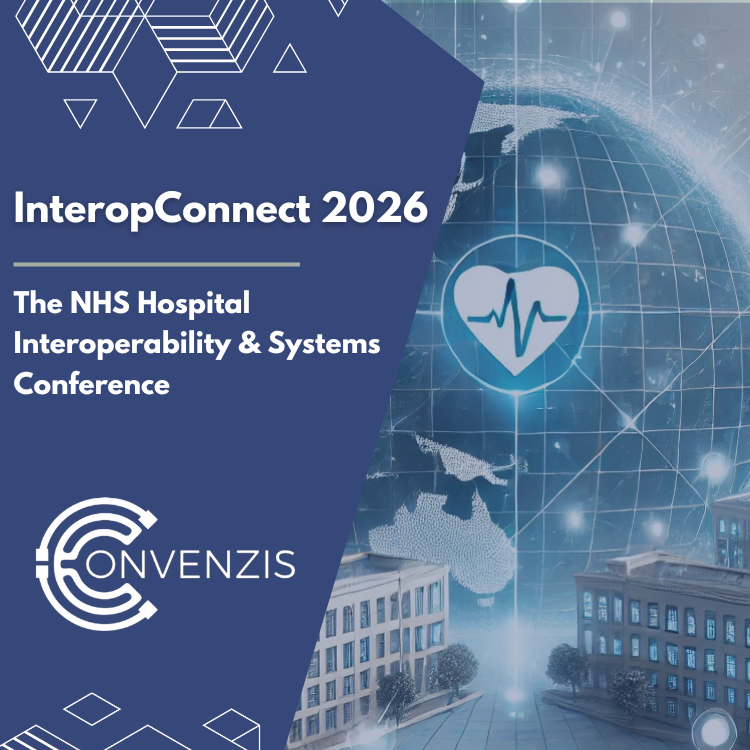
InteropConnect 2026: The NHS Hospital Interoperability & Systems Conference
A Strategic Summit on Connecting Systems, People, and Practice - All Convenzis Events Provide 8 CPD Points Per Delegate
Current landscape and challenges:
Interoperability is now recognised as a foundational requirement for NHS transformation, yet progress remains uneven across systems and pathways. While national strategies, standards and programmes are increasingly well defined, many NHS organisations continue to face challenges in translating ambition into safe, reliable and usable connections in day-to-day practice.
The most persistent barriers are rarely technical alone. Instead, interoperability programmes are often slowed by organisational complexity, unclear ownership, misaligned workflows, governance uncertainty and cultural resistance to change. Even where standards exist and systems are technically capable, challenges around trust, accountability, workforce confidence and cross-organisational collaboration continue to undermine delivery.
As the NHS moves further into system working, integrated care and cross-sector data sharing, these non-technical challenges are becoming more visible and more consequential. The question facing NHS leaders is no longer whether interoperability matters, but how it is delivered sustainably, safely and at pace across real services.
Timeliness of the event:
InteropConnect 2026 takes place at a critical moment for NHS digital and operational leaders. National expectations are accelerating through programmes such as the NHS Data for Health and Care Strategy, the Federated Data Platform and the mainstreaming of genomics and population-level services
At the same time, organisations are under pressure to demonstrate tangible benefits from digital investment, while managing workforce fatigue, service recovery and increasing scrutiny on outcomes. Many systems are now moving beyond initial implementation into optimisation, assurance and scale, where leadership, governance and culture become decisive factors.
This event is timely because it focuses on the transition from policy and programmes into lived operational reality. It provides space for NHS leaders to reflect on what is genuinely enabling progress, what is holding it back, and how to strengthen delivery capability across organisations and systems.
Key discussions and event flow:
InteropConnect 2026 is structured to take delegates on a clear and deliberate journey from national direction into the real, day to day realities of delivering interoperability in practice
The morning establishes strategic context, beginning with the national perspective from NHS England, outlining current priorities, expectations and the direction of travel for interoperability across health and care
A genomics informatics session then brings national ambition into sharp focus through real delivery experience, using genomics as a live case study to explore how national services and standards are being tested with frontline organisations, and what this reveals about governance, assurance, workflow redesign and organisational readiness at scale
As the programme progresses, the focus intentionally shifts away from technology towards people, culture and leadership, examining how interoperability succeeds or fails based on human behaviour, trust, clarity of ownership and the ability to work across organisational boundaries, even when policy and commercial barriers are removed
The afternoon broadens the lens to system wide delivery, exploring interoperability across health and social care, surfacing the realities of aligning responsibilities, incentives and workflows across sectors, and highlighting the non technical barriers that most often slow progress, including confidence, governance maturity and change fatigue
The day concludes with a practical, experience led session focused on the human and organisational foundations of interoperability, reinforcing the core message that connected care is enabled by shared understanding, collaboration and cultural alignment, not systems alone
Why attend:
InteropConnect 2026 is designed for NHS leaders who are responsible for making interoperability work in practice, not just in principle.
Delegates will gain a clear understanding of how national ambition translates into operational delivery, grounded in real NHS experience rather than theory. The programme offers practical insight into governance, leadership and organisational readiness, helping attendees reflect on their own programmes and identify where focus is needed to unlock progress.
By the end of the day, delegates will leave with a coherent view of how strategy, leadership and everyday practice must align to deliver meaningful interoperability. The event provides a rare opportunity to step back from individual projects and consider interoperability as a system-wide capability, shaped as much by people and culture as by technology.
This makes InteropConnect 2026 a valuable forum for learning, reflection and peer exchange at a time when the NHS is under increasing pressure to turn connection into impact.
Sponsors & Partners





Your Pass Includes....
- This conference is CPD accredited. Attendees will be eligible to gain 8 CPD points upon completion of the event.
- Access to a leading conference speaker programme
- Interactive Q&A sessions
- Leadership Lessons from the Front Line
- Cross-sector best practice
- Meet the supplier opportunities
- Hot breakfast & Lunch included
- Access to post event drinks reception and Street food
Tickets For NHS Senior Managers
We have an invite only option for NHS Senior Managers for our conference, to see if you qualify for a complimentary place please click the button below.
Conference Speakers



Corielyn
Bromley
Executive Director of Continued Professional Development
Association of Professional Healthcare Analysts
Read biography


Dr Ian
McNicoll
Former GP and Clinical Informatics Leader, Interoperability and Data Standards
INTEROPen
Read biography
James
Davies
Head of Digital Productivity, Transformation Partners in Health and Care (TPHC)
Royal Free NHS Foundation Trust
Read biography
Jo Bowers
ChMC
Associate Director (Digital, Data, Analytics and Digital Productivity), Transformation Partners in Health and Care (TPHC)
Royal Free NHS Foundation Trust
Read biography



The programme
08:20
Registration & Networking
Registration - Open from 8:20 am - Closes at 11:00 am
All delegates must complete their registration process before the 11:00 AM cut-off time. Please arrive in a timely manner to allow for registration and to avoid any inconvenience. Delegates who arrive after the registration deadline will be refused entry to the event.
We appreciate your cooperation in helping us maintain the event's schedule and ensuring that everyone can fully participate in the conference. If you have any questions or require assistance, our event staff will be available to assist you with the registration process.
Thank you for your understanding, and we look forward to an insightful and productive event together!
09:20
Chair Opening Address (Confirmed)
Chair Opening Address
Framing the day’s focus: how interoperability succeeds through collaboration, clinical workflow alignment, and shared accountability, not just technology.
09:30
Presentation - Interoperability Beyond Technology: Aligning People, Process and Policy in Primary Care (Confirmed)
Session Overview:
This presentation explores how national strategy, policy and operating models are shaping interoperability expectations across the NHS, with a particular focus on the impact in primary care. It will highlight what this means for GP practices, PCNs and community teams in terms of day-to-day clinical workflows, collaboration across care settings, and leadership accountability for digital transformation in practice.
09:50
Morning Skill Clinic - Genomics Interoperability in Practice, From National Standards to Local Delivery (Speakers Invited)
Session Overview:
- Demetra Georgiou, Genomic Transformation Manager, Northwest London, Vice Chair, British Society of Genomic Medicine (Confirmed)
- Christopher Smith, Senior Informatics Project Manager, North Thames Genomics Laboratory Hub, Great Ormond Street Hospital for Children NHS Foundation Trust (Confirmed)
- John Fraser, Product Owner, Genomic Order Management Service, NHS England; Informatics Director, North East and Yorkshire Genomic Medicine Service (Confirmed)
This session introduces the genomics informatics programmes led by NHS England, focused on accelerating the mainstreaming of genomic testing across the NHS. It explores how interoperability standards, including Genomic Order Management, are being developed to enable electronic requesting, reporting and integration of genomic data into clinical workflows.
The session then shifts to applied experience from the North Thames Genomic Laboratory Hub, sharing lessons from acting as an Alpha partner testing national services and standards in real environments. The discussion highlights practical challenges encountered during integration, governance alignment, workflow redesign and stakeholder engagement, and how these were addressed in partnership with NHS England.
10:30
Main Sponsor Keynote - Concentric AI
Main Sponsor Keynote - Concentric AI
Strategic insights from our headline partner on driving digital transformation in complex healthcare environments. Focus on solutions and innovations shaping the NHS digital future.
10:50
Morning Break & Networking
Morning Break & Networking
11:55
Sponsored Case Study - Solsta
Sponsored Case Study - Solsta
Solsta (part of Solid State plc) is a world-leading medical supply partner for high technology devices and a catalyst for technological innovation. Solsta has been supplying to the medical and healthcare sectors for over 50 years, both off-the-shelf and customised solutions. We understand the specific requirements and standards for medical equipment, as well as the challenges posed by component longevity and obsolescence.
Solsta also provides complete design-to-manufacture services. Our state-of-the-art UK Custom Solutions Centre features a 70 m2 ISO14644-1 class 7 cleanroom with class 5 enclosure, and we have been awarded the ISO 13485:2016 accreditation at our design and manufacturing facilities in Weymouth and Pangbourne. With a proven track record in providing the quality and reliability needed for medical applications, we offer bespoke design and production engineering solutions with a focus on optoelectronic, display, sensor, detector, and laser technologies.
We can provide bespoke cabling and housing assemblies, and replacements for obsolete products that are ‘like for like’ both mechanically and electronically. We help the medical community to solve problems, drawing on unmatched technical knowledge, connections and entrepreneurial spirit.
Operating at the heart of the electronics industry, we’re the trusted partner for our customers and suppliers. Solsta is the vital component linking up the electronics community.
12:15
Sponsored Case Study - Who’s Who? Surviving the Wild West of Identity Security!
Sponsored Case Study - ManageEngine
Navigating today’s identity security landscape means facing fragmented systems, rising machine identities, and persistent data silos. “Who’s Who?” tackles the chaotic ‘Wild West’ of identity threats, offering strategies to unify, secure, and manage identities—helping organisations survive relentless cyber risks and compliance burdens.
12:35
Leadership Interview - Developing Digital Confidence and the Next Generation of NHS Leaders (Confirmed)
Session Overview:
This leadership interview explores how digital confidence is built across clinical teams and why interoperability depends as much on people as it does on systems.
12:55
Skills Clinic - Automating “Waiting Well”: How Interoperable CareQ Pathways Support Patients at Scale
Session Overview:
This session reframes waiting list management through a digital and interoperability lens. It explores how automated, interoperable CareQ pathways enable Trusts and Health Boards to support patients consistently while they wait without adding clinical or administrative burden by integrating with existing digital infrastructure and communication channels.
The focus is on how CareQ fits into the digital ecosystem, complements EPRs and patient engagement platforms, and enables scalable patient support aligned with NHS interoperability and digital maturity priorities.
Session Learning Outcomes - By the end of the session, participants will be able to:
- Reframe waiting list management as a digital and interoperability challenge, not just an operational one.
- Describe how CareQ functions as an automated, interoperable engagement layer that complements EPRs, PAS, and patient portals.
- Understand how automation enables continuous patient support at scale, without increasing clinical or administrative workload.
- Explain how CareQ uses interoperable workflows to deliver safe, assured digital health tools to patients while they wait.
- Articulate the digital governance value of ORCHA assessment and ORCHA Assured status for reducing risk and procurement friction.
- Identify opportunities to embed automated “waiting well” pathways within their organisation’s digital architecture and transformation roadmap.
13:15
Lunch & Networking
Lunch & Networking
Hot buffet and informal discussion opportunities with NHS peers and suppliers.
14:00
Leadership is only ever about the people... (Confirmed)
Session Overview:
Leadership tactics I have found useful when delivering Digital Transformation projects – how to keep the Executive focussed on the true costs and the realisation of clinical benefits.
14:20
Main Plenary Skill Clinic – Solving Non-Technical Obstacles to Interoperability (Speakers TBC)
Dr Ian McNicoll, Former GP and Clinical Informatics Leader, Interoperability and Data Standards, INTEROPen (Confirmed)
Dr Sabarna Mukhopadhya, Award-Winning Digital Health Leader 2025 | Solving Complex Healthcare Challenges with Clarity, Leadership & Impact | Digital Transformation Consultant (invited)
Session Overview:
Interoperability challenges in the NHS are often assumed to be technical, yet many of the most persistent barriers remain even when systems, standards and policy constraints are removed. This session focuses on the practical, human and cultural factors that continue to limit joined-up care in real NHS settings.
Drawing on frontline and national experience, the session explores how behaviours, trust, professional boundaries, governance clarity and organisational culture shape whether interoperability initiatives succeed or stall. Rather than focusing on standards or technology, the discussion centres on how people work together, how decisions are made, and how ownership and accountability are established across organisations.
14:40
Breakout Skill Clinic - Automating for Interoperability: The Royal Free Playbook (Confirmed)
Session Overview:
A deep dive into how automation can be used safely to strengthen interoperability and clinical workflows.
15:00
Food, Drinks & Networking
Food, Drinks & Networking
17:00
End of Day
End of Day