Slides
Gallery
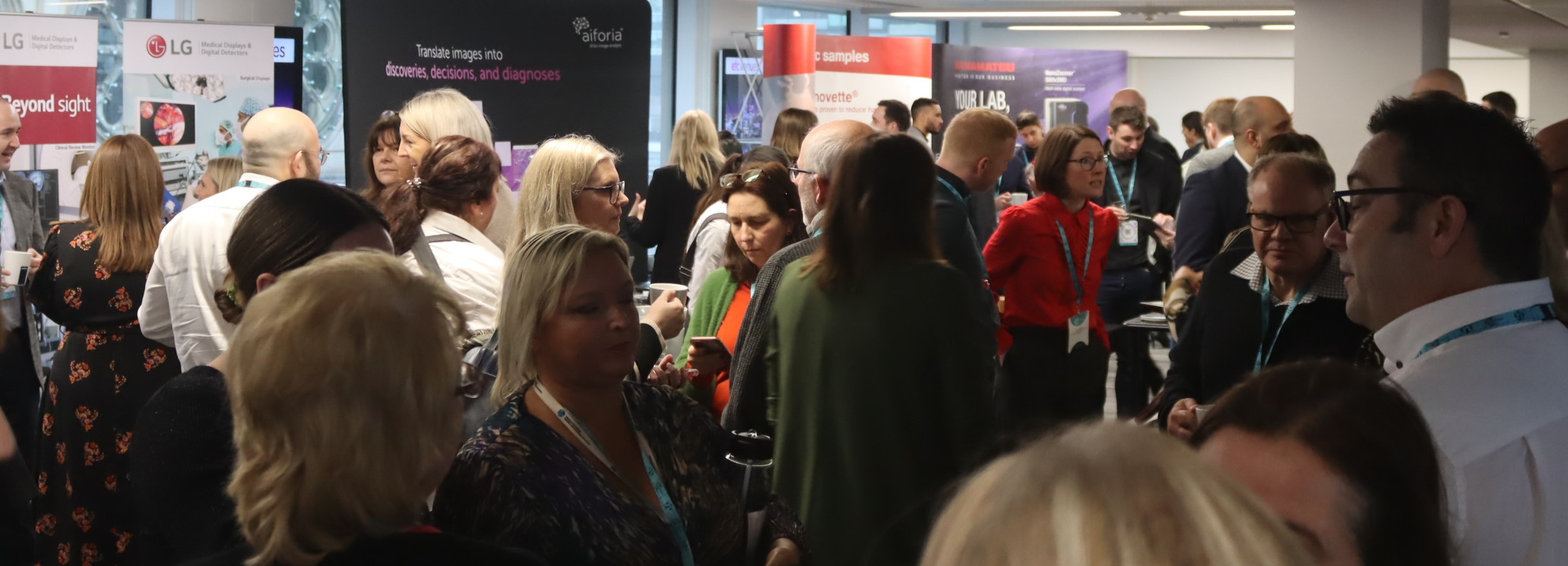
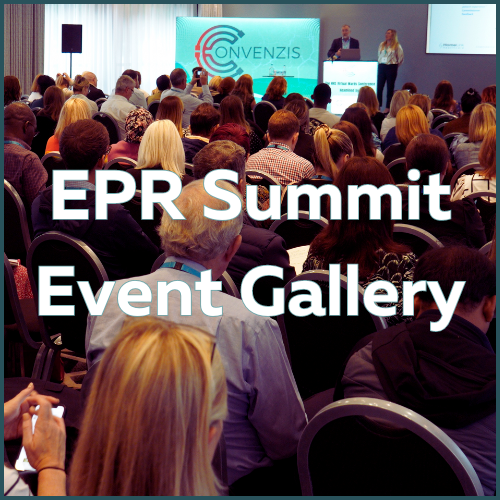 EPR Summit Event Gallery Series

All Convenzis Events Provide 8 CPD Points Per Delegate
Parking: We have access to complimentary parking in the South 6 Car Park. You will receive a parking ticket upon arrival, please bring this with you to the Venue so that they can validate your parking before you leave the car park.
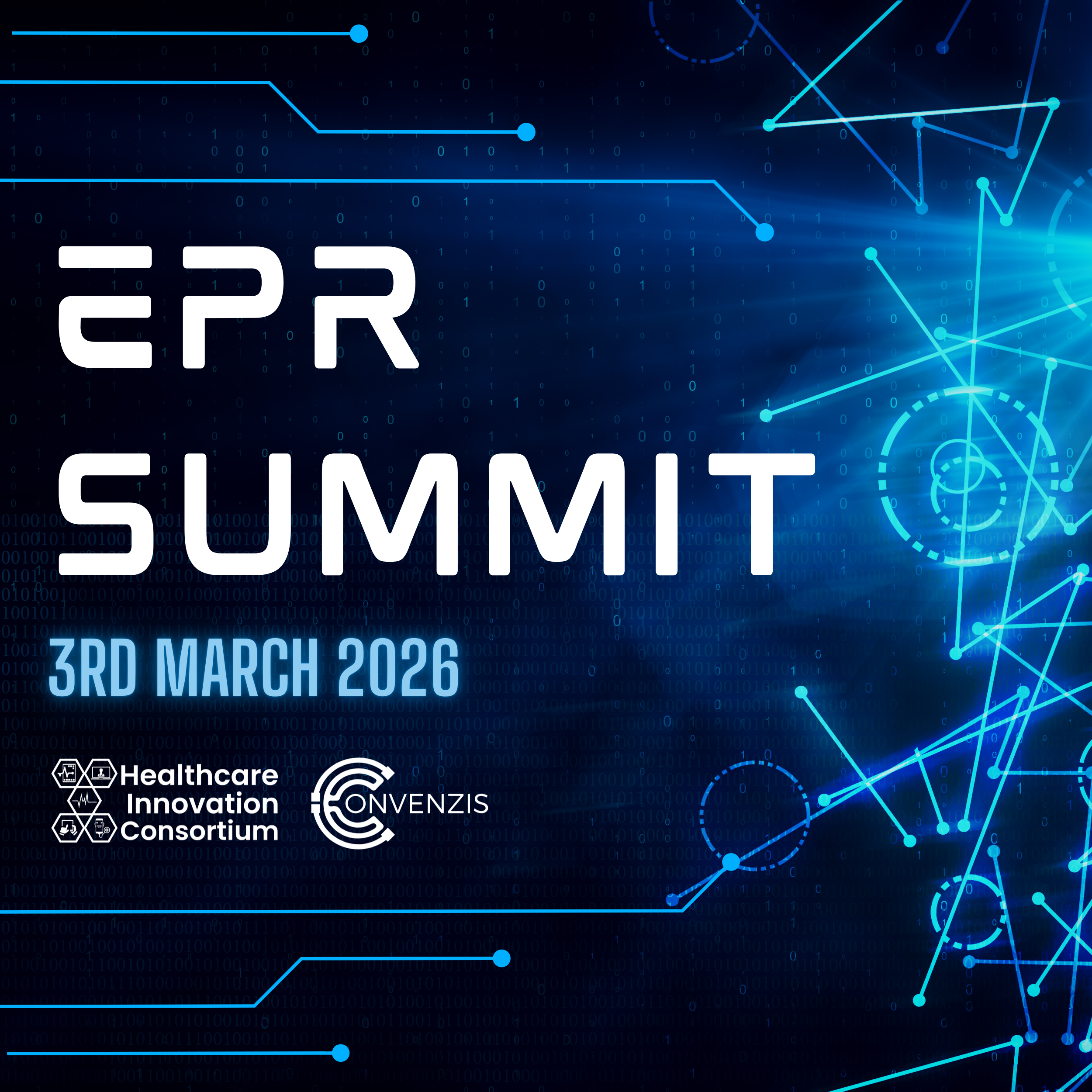
Delivered in partnership by Convenzis Group and Healthcare Innovation Consortium
Strategic Foundations for Digital Care
Current landscape and challenges:
England has reached near universal EPR coverage across NHS trusts, but this achievement has exposed a new and more complex set of challenges. While systems are live, many organisations are struggling to translate digital capability into consistent improvements in productivity, clinical quality and staff experience. Digital maturity varies significantly between trusts and ICSs, with some organisations using EPRs as transformational platforms while others remain focused on documentation and compliance.
National frameworks such as What Good Looks Like and the Digital Maturity Assessment provide direction, but local leaders continue to face uncertainty about how these expectations should be operationalised in practice. Funding models remain fragmented, with capital investment historically prioritised over optimisation, interoperability and workforce enablement. Procurement processes are often lengthy and duplicated, slowing progress and limiting convergence across systems. As digital becomes core infrastructure rather than a programme, clarity on governance, accountability and long term direction is increasingly critical.
Timeliness of the event:
2026 represents a clear inflection point for England’s digital agenda. With frontline digitisation largely complete, the national focus is shifting decisively toward optimisation, outcomes and system wide alignment. NHS England is signalling a move away from funding technology adoption toward funding better care, efficiency and safety. At the same time, expectations around interoperability, data quality and cross setting workflows are increasing, particularly at ICS level.
This summit is timely because leaders now need a shared understanding of what good looks like beyond go live, how to prioritise investment, and how to move from strategy to delivery at scale. It creates space for senior decision makers to step back from operational noise and align on the foundations required for the next phase of digital care.
Key discussion points:
Why attend:
This summit supports senior NHS leaders who are responsible for turning digital ambition into reality. Delegates will gain strategic clarity, hear honest reflections from peers facing similar pressures, and leave better equipped to make informed decisions about investment, governance and delivery. It is designed to help organisations move from having an EPR to truly using it as a foundation for safer, more efficient and more connected care.
Attendance Policy:
Please note that attendance at this event is strictly by pre-registration only. Only registered NHS delegates and approved attendees will be admitted on the day. Private sector representatives or unregistered guests will not be permitted entry.
If you have not received a confirmation email, please contact info@convenzis.co.uk before attending and our team will reissue your registration details.
If your place has been declined and you believe this may have been in error, please email info@convenzis.co.uk and our team will be happy to review your application.














We have an invite only option for NHS Senior Managers for our conference, to see if you qualify for a complimentary place please click the button below.


Digital Services for Integrated Care | Digital Primary Care | NHS England
Read biography



University Hospitals Coventry and Warwickshire
Read biography


Bedfordshire Hospitals NHS Foundation Trust
Read biography
Worcestershire Acute Hospitals NHS Trust
Read biography
One Lancashire and South Cumbria CIO
Read biography
Sandwell & West Birmingham NHS Trust
Read biography
The Rotherham NHS Foundation Trust
Read biography




Registration & Networking
Attendance Policy:
Please note that attendance at this event is strictly by pre-registration only. Only registered NHS delegates and approved attendees will be admitted on the day. Private sector representatives or unregistered guests will not be permitted entry.
If you have not received a confirmation email, please contact info@convenzis.co.uk before attending and our team will reissue your registration details.
If your place has been declined and you believe this may have been in error, please email info@convenzis.co.uk and our team will be happy to review your application.
Chair Opening Address (Confirmed)
Chair Opening Address
A welcome to delegates and framing of the summit focus.
Keynote Presentation - Driving productivity on the frontline through optimisation (Confirmed)
Derm will share insights from the national team on current strategy, programme progress, and emerging priorities for EPR optimisation. With 94% of NHS Trusts now live with an EPR, the focus is shifting from adoption to optimising these assets to deliver measurable improvements for staff and patients to truly transform care and improve system-wide outcomes. He will also outline how national frameworks, including the NHS Ten Year Plan, are shaping these efforts and the important role we all have in achieving those objectives.
Derm will host a 10 Minute Q&A at the end. Submit your questions here - https://tally.so/r/Npo1DW
Presentation - Foundations Under Pressure: Applying Pre‑Hospital Principles to Strengthen EPR‑Enabled Care (Confirmed)
Session Overview:
High‑pressure clinical environments expose weaknesses in digital workflows long before any formal review does. As a recent paramedic‑turned‑CXIO, I’m discovering how clarity, predictable information flow, and well‑supported teams shape how effectively an EPR performs on the wards. Across Worcestershire, this is informing our approach not only to our recent ePMA deployment, but also to other digital priorities such as sepsis enhancements, ambient voice technology, and workforce readiness.
This session will share practical lessons from engaging directly with ward teams, addressing gaps uncovered during operational pressure, and reflecting on successes and failures in alignment of digital change with clinical expectations. It will also outline how these foundations are shaping upcoming work, including electronic bed capacity management, ensuring our EPR supports safer, more consistent care across the Trust.
Main Sponsor - Unlocking value in your EPR: A clinician’s perspective
Main Sponsor - Altera Digital Health
Session Overview:
Morning Break & Networking
Morning Break & Networking
Chair Morning Reflection (Confirmed)
Chair Morning Reflection
Summary of morning themes and introduction to mid-day sessions.
Case Study - AI at the Edges: The Next Productivity Gains Won’t Come From Your EPR
Case Study - Aire Logic
With EPR adoption largely complete, the next wave of NHS productivity gains is unlikely to come from replacing core systems, but from removing the friction between them. Despite digital maturity progress, frontline teams continue to manually upload documents, rekey referral information and code inbound correspondence where integration remains limited
This session explores where automation and artificial intelligence is already delivering measurable impact, not by transforming the EPR itself, but by strengthening the workflows around it.
Through practical examples, it will demonstrate how AI can structure inbound paper documents in seconds, validate referral completeness before submission, digitise paper-based pathways and convert patient-reported outcomes into structured, reusable clinical data. Deployed within existing governance frameworks, these targeted interventions reduce duplication, improve data quality and deliver tangible productivity improvements within weeks.
If optimisation is the priority for 2026, the opportunity may not lie in what sits inside the EPR, but in what happens at its operational edges.
Case Study - Next‑Gen EPR Hosting: building secure, resilient and UK‑sovereign foundations for digital care
Case Study - Proact IT LTD
Session Overview:
In this session, we’ll explore how you can turn EPR capability into measurable improvements in productivity, clinical quality and employee experience. We’ll share how modern, secure and UK-sovereign cloud foundations can support the next phase of EPR hosting, improving cost efficiency, strengthening security controls and enhancing resilience.
Alongside this, you’ll hear a real-world perspective from Laura Mumby, The Rotherham NHS Foundation Trust on how improving digital maturity is directly enhancing patient outcomes, building a stronger, safer foundation for future care.
Joined-Up Care Across Settings – Making Electronic Patient Records Work for the Whole System (Confirmed)
Case Study - Strategic Foundations for Digital Care - A CCIO's Blueprint
Case Study - Dedalus
Session Overview:
Lunch & Networking
Lunch & Networking
Chair Afternoon Address (Confirmed)
Chair Afternoon Address
Setting up the afternoon’s maturity and optimisation focus.
Case Study - From Digitisation to Productivity: Turning National Investment into Frontline Impact
Case Study - BridgeHead Software
Session Overview:
The NHS has invested heavily in digitisation over the past decade, particularly through EPR adoption, establishing essential digital foundations across secondary care. However, as NHS England has made clear, digitisation alone does not deliver sustained frontline productivity. This session explores why productivity loss often occurs between systems rather than within them driven by fragmented patient information, legacy technology drag, and the ongoing effort required to reconstruct patient history. It examines how moving from isolated data fragments to a coherent, trusted patient record can reduce risk, remove inefficiency, and turn national digital investment into meaningful frontline impact, enabling one patient story to be understood across organisations, care settings, and time — without adding complexity.
Presentation - Interoperability: A clinicians perspective from the coalface of healthcare (Confirmed)
Session Overview:
Moving beyond high-level digital strategy, this session exposes the critical gaps in healthcare interoperability through the eyes of a frontline surgeon. It contrasts the promise of "digital maturity" with the reality of data silos and physical implant cards that leave clinicians "digitally blind" in emergencies. The presentation argues for a fundamental architectural shift toward an Open Platform approach (using openEHR) that separates data from applications to ensure true semantic interoperability. Featuring the openOutcomes case study, it demonstrates how a "collect once, use many times" model can eliminate administrative burden, populate national registries automatically, and crucially, close the loop on patient safety.
Case Study - Discovery Before Deployment: A Productivity-First Approach to EPR Optimisation
Case Study - InterSystems
Session Overview:
Productivity gains and improved clinical outcomes are the primary justification for EPR investment. NHS England's strategy now makes this explicit: the focus is shifting from technology acquisition to technology exploitation from deploying EPR solutions to realising measurable value from them.
This presentation sets out the InterSystems approach that places service transformation, not system deployment, at the heart of programme delivery. A rigorous, service-led discovery methodology grounds productivity investment in evidenced workflows rather than assumed ones addressing the core risk that accompanies every shift from acquisition to exploitation.
To illustrate the approach, we draw on a recent national-scale programme for the Health Service Executive in the Republic of Ireland, where a 40-week structured discovery engaged frontline staff and executives across six regions to build a clinically-validated blueprint before a single implementation decision was taken.
The session concludes by examining why, as AI-based solutions accelerate across healthcare, the case for evidence-based discovery has never been more critical. AI amplifies whatever it finds and without a rigorous understanding of current-state workflows and behaviours, it will accelerate dysfunction, not productivity.
Panel Discussion - EPR Optimisation Challenges (Confirmed)
Making EPRs Work for Staff: Funding, Workforce and Maturity
Frontline Digitisation has delivered EPR coverage across 90% of Trusts but owning a system isn’t enough. This session examines how to optimise EPR use through workforce alignment, better funding models and strategic maturity planning, ensuring digital tools truly support staff and patients.
NHS Case Study - From Frontline Pressure to Digital Progress: Lessons From the Ambulance Service (Confirmed)
Session Overview:
David shares candid stories from the ambulance sector where fragmented systems, data gaps, and operational pressures collide and highlights how new technologies and smarter integration can transform response, safety, and flow. He will make the case for a standardised, connected EPR ecosystem that still respects the needs of each clinical environment.
Panel Discussion - Aligning national policy with frontline EPR delivery (Confirmed)
Facilitator:
Canapés & Drinks
Canapés & Drinks
End of Day
End of Day
EPR Summit Event Gallery Series